CASE STUDY 02 · PREDICTION MARKET
Making prediction markets understandable to CEX users.
Designing a cross-platform product that helps users discover events, understand unfamiliar market mechanics, place trades, and manage positions across web, iOS, and Android.
ROLE
Senior Product Designer
SCOPE
Product Strategy, Research, UX/UI Design
USERS
CEX Users New to Prediction Markets
PLATFORMS
Web, iOS, Android
PRODUCT
Cross-platform Prediction Market

EXECUTIVE SUMMARY
01
Problem
CEX users understood prices, Buy and Sell, orders, and PnL, but did not necessarily understand outcomes, probabilities, shares, or event settlement.
02
Research
Market analysis, competitor research, user mental-model interviews, sports-market taxonomy, comprehension testing, and cross-platform validation.
03
Product response
A layered product framework organized around event discovery, event understanding, market selection, outcome trading, position management, and settlement.
04
Outcome
A scalable prediction-market system supporting multiple market types across web and mobile.
The main challenge was not teaching users a completely new financial interface. It was identifying which CEX conventions reduced learning cost — and which conventions created incorrect assumptions.
KEY RESEARCH INSIGHTS
Six findings that shaped the product.
Mobile is a funnel — it has to convert a sports fan or Binance app user into someone who has placed one bet. Desktop is a terminal — it has to retain a trader who prices, sizes, and manages positions. Every screen below serves one of those two jobs.
INSIGHT 01
Browsing is a feed of pre-priced opinions, not a market directory.
OBSERVATION
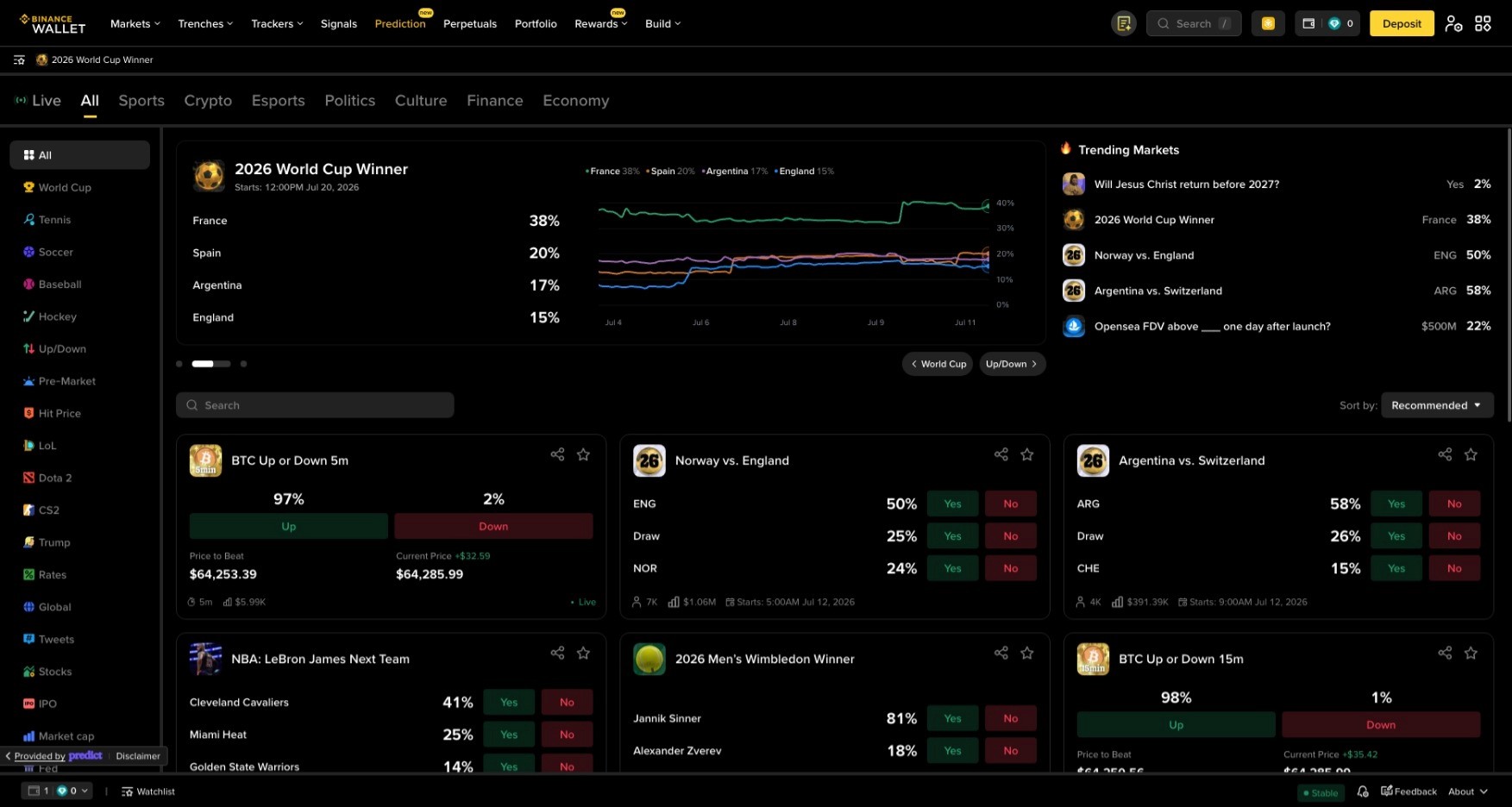
The Markets tab stacks cards where every outcome already ships with its probability and a Yes/No button attached — ENG 50%, Draw 25%, NOR 24%. The user never lands on a “market” and then has to work out how to express a view.
APPROACH
Collapse discovery and order entry onto the same surface.
RATIONALE
The conversion killer is the gap between “I think England wins” and “I own 100 ENG shares at 0.51.” A green Yes beside a percentage closes that gap to one tap — the card is the ad and the order ticket at once.

INSIGHT 02
The trade screen is a price-taker’s screen — order book demoted, one button promoted.
OBSERVATION
On the BTC 5m and match screens the sequence is Up/Down → Buy → Market → amount → Buy Up. The ladder is a side column or a collapsed accordion, and preset chips ($1 / $5 / $10 / $50) replace free-text entry.
APPROACH
Remove every decision a beginner cannot make.
RATIONALE
Market-by-default plus a $1 chip means the first trade costs almost nothing in money or cognition. The ladder stays available for the minority who want it, but it never blocks the path to the button.

INSIGHT 03
Percentage is the only number a new user has to learn.
OBSERVATION
Everything user-facing is stated as 51% / 25% / 24%; USDT cents like 0.51 only appear once the user opens the order book, and “To Win” is shown instead of payout multiples.
APPROACH
Present the order book in the vocabulary of the incoming audience.
RATIONALE
Sports bettors already reason in “England has a 50% chance,” not in shares. Leading with probability lets someone trade a real order book without ever being taught what a share is.

INSIGHT 04
Up/Down and Football Cup earn dedicated tabs — they are the two on-ramps.
OBSERVATION
Rather than living inside a generic market list, the 5-minute BTC binary and the World Cup zone each own a bottom-nav slot — the latter with a countdown, a podium of consensus favourites, and a live bracket.
APPROACH
Give each acquisition wedge a permanent front door and a reason to return before the user has a position.
RATIONALE
Up/Down needs no domain knowledge and resolves in five minutes, so it converts on impulse. The World Cup zone converts on identity — the bracket and podium are content, not markets, building the habit of opening the tab.

INSIGHT 05
Desktop browsing is a scanner: category rail, trending list, volume on every row.
OBSERVATION
World Cup, Tennis, Trump, Fed, IPO down the rail; Trending Markets on the right; $1.06M volume, 7K traders, and full moneyline / spread / totals columns on every match row.
APPROACH
Surface liquidity and coverage, not appeal.
RATIONALE
A pro is not shopping for a market to enjoy — they are hunting for mispricing they can get size on. Volume and trader count are the qualifying signal, and the flat rail lets them sweep the entire book in one pass.
INSIGHT 06
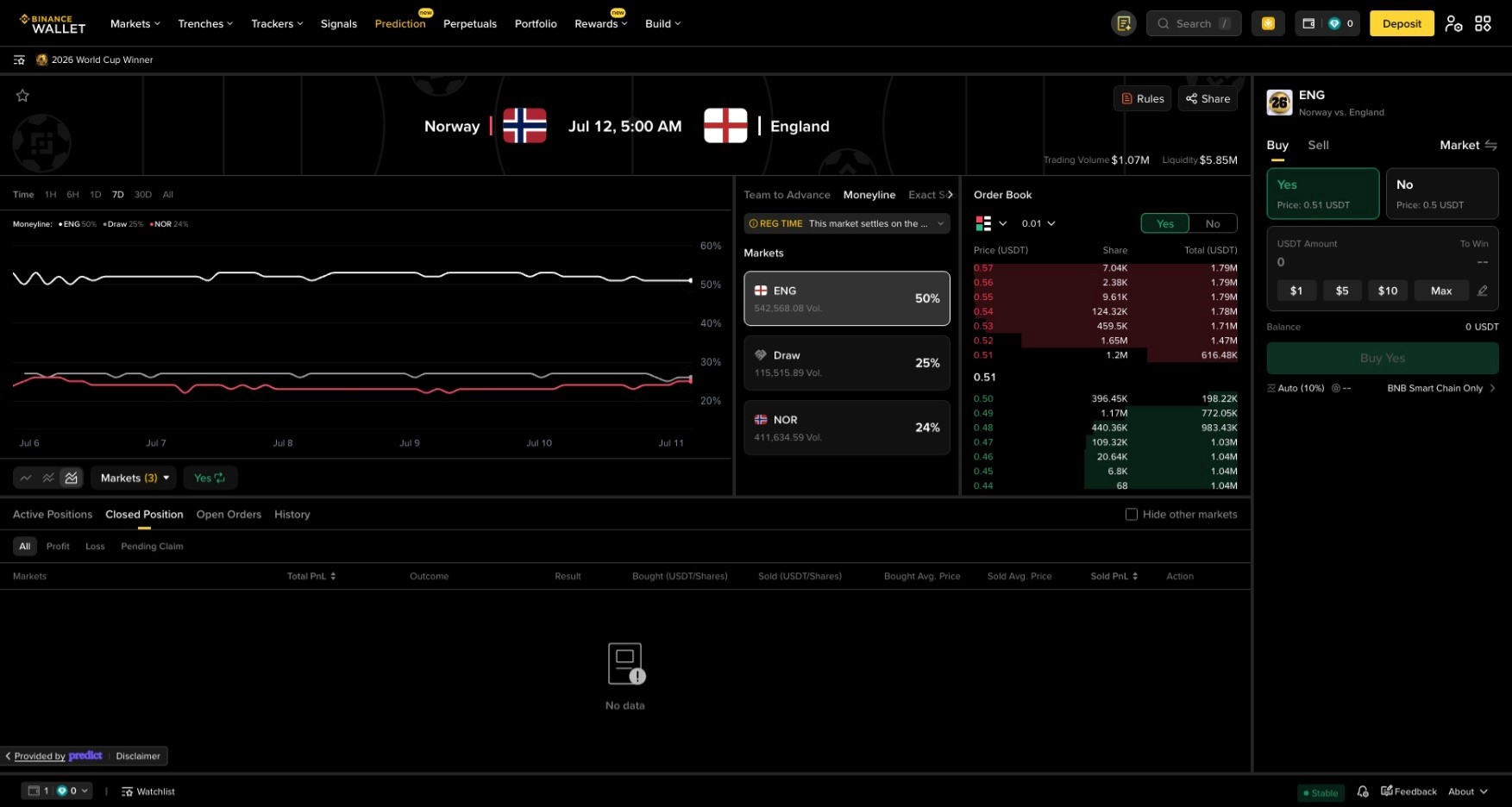
The desktop trade screen is a three-column terminal: chart, order book, ticket.
OBSERVATION
A 7-day probability chart with all three moneyline legs overlaid, the full ladder with size at every tick (0.57 → 0.44), and a pinned Buy/Sell panel with Limit and Max — plus Active Positions, Open Orders, and History docked below.
APPROACH
Zero navigation between the four questions a trader asks in sequence.
RATIONALE
Is 51% rich against the week’s range? Is there depth to fill the size? Should a limit rest inside the spread? What do I already hold? Closing any one panel breaks the loop — the exact inverse of mobile.
CROSS-PLATFORM STRATEGY
Market segments across two platforms.
DESKTOP · THE PRO TERMINAL
Retain a trader who prices, sizes, and manages positions across markets.
LAYOUT
Global + category navigation
Event context and chart
Market selection + Order Book
Persistent order panel
Positions and history
PRINCIPLES
High information density
Minimal page switching
Persistent trading controls
Support for Limit orders
MOBILE · THE ACQUISITION FUNNEL
Convert a sports fan or Binance app user into someone who has placed their first bet.
FLOW
Discovery → Event detail → Market type → Outcome → Order → Position
PRINCIPLES
One primary task per screen
Progressive disclosure
Large outcome controls + quick amounts
Collapsible Order Book
Persistent rules and payout context
The product model underneath stays identical — but mobile is tuned for the first bet, and desktop is tuned for the hundredth.
FINAL EXPERIENCE & REFLECTION
The system, end to end.
Lower learning cost
Familiar CEX trading mechanics were used as an entry point, while unfamiliar prediction concepts were explained within the flow.
Scalable market framework
Different markets shared a common transaction model while preserving market-specific interaction patterns.
Cross-platform consistency
Web supported comparison and advanced execution, while mobile supported focused and faster decision-making.
Greater trust
Rules, timing, settlement, payout, and position states were treated as core product information, not secondary documentation.
MEASUREMENT · DATA PENDING VERIFICATION
cross-category retention
67.58%
orders per trader
18.2
volume per trader
$916
Active traders
197,662
The central challenge was not deciding whether to reuse CEX interaction patterns. It was deciding where familiarity reduced learning cost — and where it created incorrect assumptions about the meaning of an outcome, a position, or a settlement.
KEY TAKEAWAY
I used market and user research to define how CEX users understand prediction markets, participated in building the Event–Market–Outcome–Order–Position–Settlement product model, and translated it into a consistent cross-platform experience.
Research
Competitor analysis
Mental-model interviews
Comprehension testing
Cross-platform validation
Product strategy
Product framing
User segmentation
Market taxonomy
Feature prioritization
Shared product model
Execution
Information architecture
Web and mobile UX
Market-specific interactions
Rules and settlement states
Scalable component framework
NEXT
Let’s design clearer, more trusted financial products.
Previous Case Study · Professional DEX Trading